| Symbol | Format | Data |
|---|---|---|
| √ | Code Point |
U+221A |
| TeX |
\surd |
|
| TeX |
\sqrt{}
|
|
| SVG | Download ↓ |

In math, the radical symbol by itself is used to represent taking the square root of an expression. Typically the radical symbol is used in an expression like this:
In plain language, this means “the square root of four is equal to two”. By convention, the square root always returns the positive root, called the principal root, to make the result unambiguous. Read more…
When a number is placed above the radical mark, the symbol represents taking the -th root of an expression, where is the number written as shown below
In plain language, this means “take the -th root of the number ”. The same convention carries over: an even gives the positive root, while an odd has only one real root to begin with. Read more…

The plus-minus symbol is used in math to represent both positive and negative results from a calculation. It also indicates the error or uncertainty in measurements.

The square root of a number is the value that, when multiplied by itself, equals that number. Written with the radical symbol √, it returns the principal (positive) root.
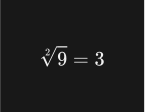
The radical operator returns the n-th root of the provided expression. The radical operator is an alternative way of writing a fractional exponent.