The square root of a number is the value that, when multiplied by itself, equals the number. For example, the square root of is , because .
The square root of a number has a nice relationship to the geometry of squares. When you draw a square, like the one illustrated below with an area of 9 units², the square root of the area of the square is equal to the side length.
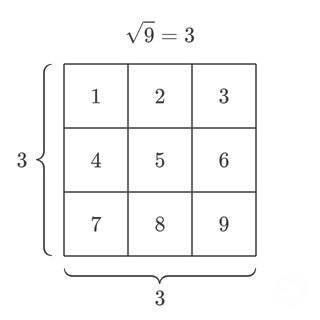
The geometry is easiest to read when the area is a perfect square like , , , and so on, but the same idea extends to any non-negative number. Plotted as a function, the square root looks like this:
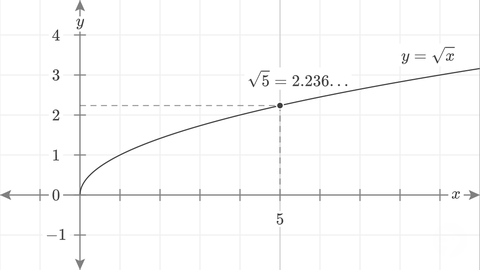
Now you may be thinking, there are two possible roots of a number. For example, the roots of the number are and . By convention, the square root operator only returns the positive root of a number, called the principal root. This makes it so the operator produces a clear and unambiguous result like .
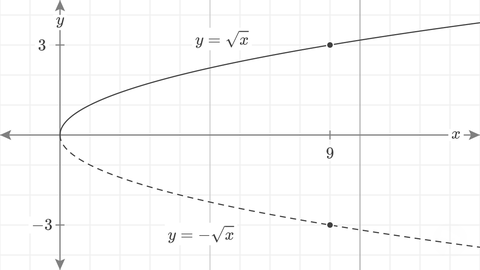
When you want to indicate that there are two possible roots of a number, use the ± symbol. For example, to write the two solutions satisfying the equation :
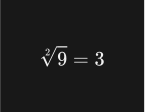
The radical operator returns the n-th root of the provided expression. The radical operator is an alternative way of writing a fractional exponent.
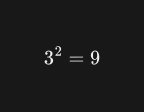
The exponentiation operator is a binary operator. The base is an expression or number that is being raised to some exponent. The exponent expression is denoted using superscript text.