In algebra, a square root usually appears in an expression like this:
In plain language, this means “the square root of is equal to ”.
The small number tucked into the radical is called the index, and it says which root to take. A square root leaves it out, so a bare radical always means the second root.
Both expressions mean the same thing but, in practice people, people rarely write the index. Every other root spells its index out: is the cube root, is the fourth root. See the radical notation for the general -th root.
A root can also be written as an exponent. Taking the square root of an expression is the same as raising it to the one-half power.
So the expression at the top of this page has a second spelling.
The two forms are interchangeable. This site writes the radical when the point is “take a root” and the exponent when the root sits inside a larger chain of powers, where a fraction in the superscript is easier to combine with the exponents around it.
To calculate the square root of a number see this page.
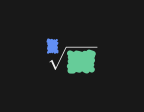
In math, we use the √ symbol to represent the square root and the n-th root of an expression.
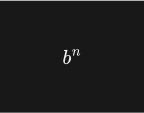
In mathematics superscript text is used to indicate the exponent of some number.