| Symbol | Format | Data |
|---|---|---|
| β | Code Point |
U+03B2 |
| TeX |
\beta |
|
| SVG | Download ↓ |

The Greek small letter (beta) is used throughout mathematics and physics as a variable standing for an unknown or changing quantity, and as a coefficient or parameter standing for a value fixed by the context.
As a variable, often represents an angle. In this context, it is typically the second angle in a figure, after (alpha). For example, this is how beta appears in the sum of two angles identities:
As a coefficient or parameter, denotes a value that is held fixed for a given problem but determined by its context rather than being a known constant. For example, and are the coefficients of a simple linear regression model:

The capital Greek letter beta (Β) is visually very similar to the Latin capital letter B. Refer to Capital B for how the symbol appears in math.

The 'α' is a letter of the Greek alphabet. In mathematics, physics, and engineering, it is often used to denote an angle, a coefficient of thermal expansion, an alpha particle, among other uses.

The Greek letter γ (gamma).
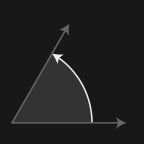
An angle is the figure formed by two rays sharing a common endpoint called the vertex. Its size, measured in degrees or radians, is the amount of rotation needed to align one ray with the other.
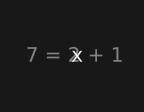
A variable is a symbol that represents an unknown or indeterminant quantity. Variables can represent numbers, vectors, or other mathematical objects, depending on the context.
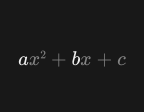
A coefficient is a numerical or constant quantity placed before and multiplying the variable in an algebraic expression.

In mathematics, a parameter is a quantity that influences the output but remains constant within specific scenarios. In statistics, parameters are values that represent characteristics of an entire population. In computer science, parameters are values passed to a function or method.
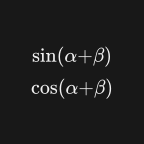
The sum of two angles identities are trigonometric identities that express the cosine and sine of the sum of two angles in terms of the trigonometry of the individual angles.