-
geometryat a right angle to the line, surface, or plane."The axes of a coordinate system are perpendicular to each other."Similar:orthogonal
In geometry, two lines or planes are said to be perpendicular if they intersect at a right angle, which is an angle of degrees.
For example, in the Cartesian coordinate system, the -axis and -axis are perpendicular to each other.
Similarly, the edges of a square or rectangle are perpendicular to each other, as are the faces of a cube or rectangular prism.
The symbol for perpendicularity is ⊥. For example, if you have two lines, and , you can write to mean “line is perpendicular to line ”.

A line is a straight, one-dimensional figure that extends infinitely in both directions.
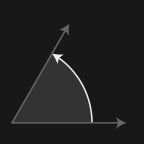
An angle is the figure formed by two rays sharing a common endpoint called the vertex. Its size, measured in degrees or radians, is the amount of rotation needed to align one ray with the other.

A right angle is an angle of exactly 90 degrees, a quarter of a full turn.

In mathematics, orthogonal refers to a concept involving right angles. In Euclidean space, two vectors are orthogonal if they are at right angles to each other. In linear algebra, two vectors are orthogonal if their dot product is zero.

A perpendicular angle is equal to a quarter of a full rotation. A perpendicular angle is measured as 90 degrees or π/2 radians.

In geometry, the perpendicular symbol is used to show that two lines are perpendicular to each other. Visually, the symbol is made up of two lines that form a perpendicular angle.