The right-hand rule is used to determine whether a coordinate system is right-handed, the positive direction of rotation around an axis in such a system, and the direction of the vector returned by the cross product in such a system.
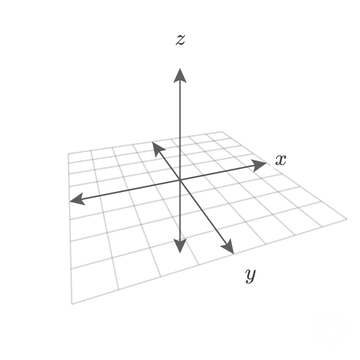
The reason the right-hand rule exists is because there are two ways to construct a 3D coordinate system. A quick way to visualize both types of coordinate systems is to draw a coordinate system, label the axes, and reflect that coordinate system using a mirror.

These two coordinate systems are distinct from each other. In other words, there is no way to rotate one of these coordinate systems so that their positive axes all line up and point the same direction. They are called left-handed and right-handed coordinate systems, and the right-hand rule is the test that tells them apart.
To determine if a coordinate system is right-handed, point the index finger of your right hand in the direction of the positive -axis and your middle finger in the direction of the positive -axis. If your thumb points in the same direction as the positive -axis, the coordinate system is right-handed.

Once you’ve established the handedness of the system, the rule has two more uses: finding the positive direction of rotation around an axis, and finding the direction of the vector returned by the cross product.
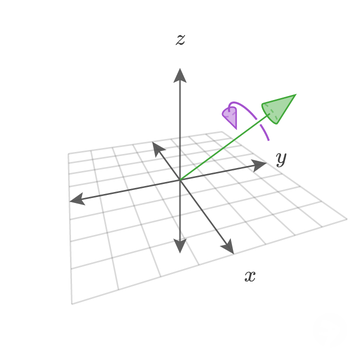
In a right-handed coordinate system, the right-hand rule determines the positive direction of rotation around an axis. Stick the thumb of your right hand in the direction of the axis and curl your fingers. The direction your fingers curl is the positive direction of rotation.

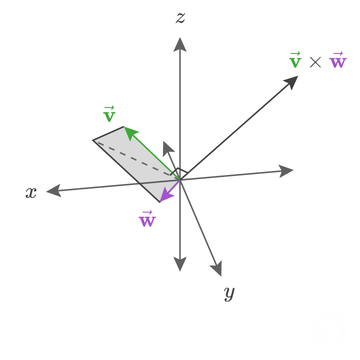
In a right-handed coordinate system, the right-hand rule also determines the direction of the vector returned by the cross product. Point the index finger of your right hand in the direction of the first vector and your middle finger in the direction of the second vector. Your thumb then points in the direction of the cross product. This is the same hand position as the handedness test, with the axes relabeled as vectors.

-
Cross Products | 3Blue1Brown